PENG9570 — Lecture 8
Uniqueness theorem for solution of the 1D heat / diffusion IBVP
The IBVP:
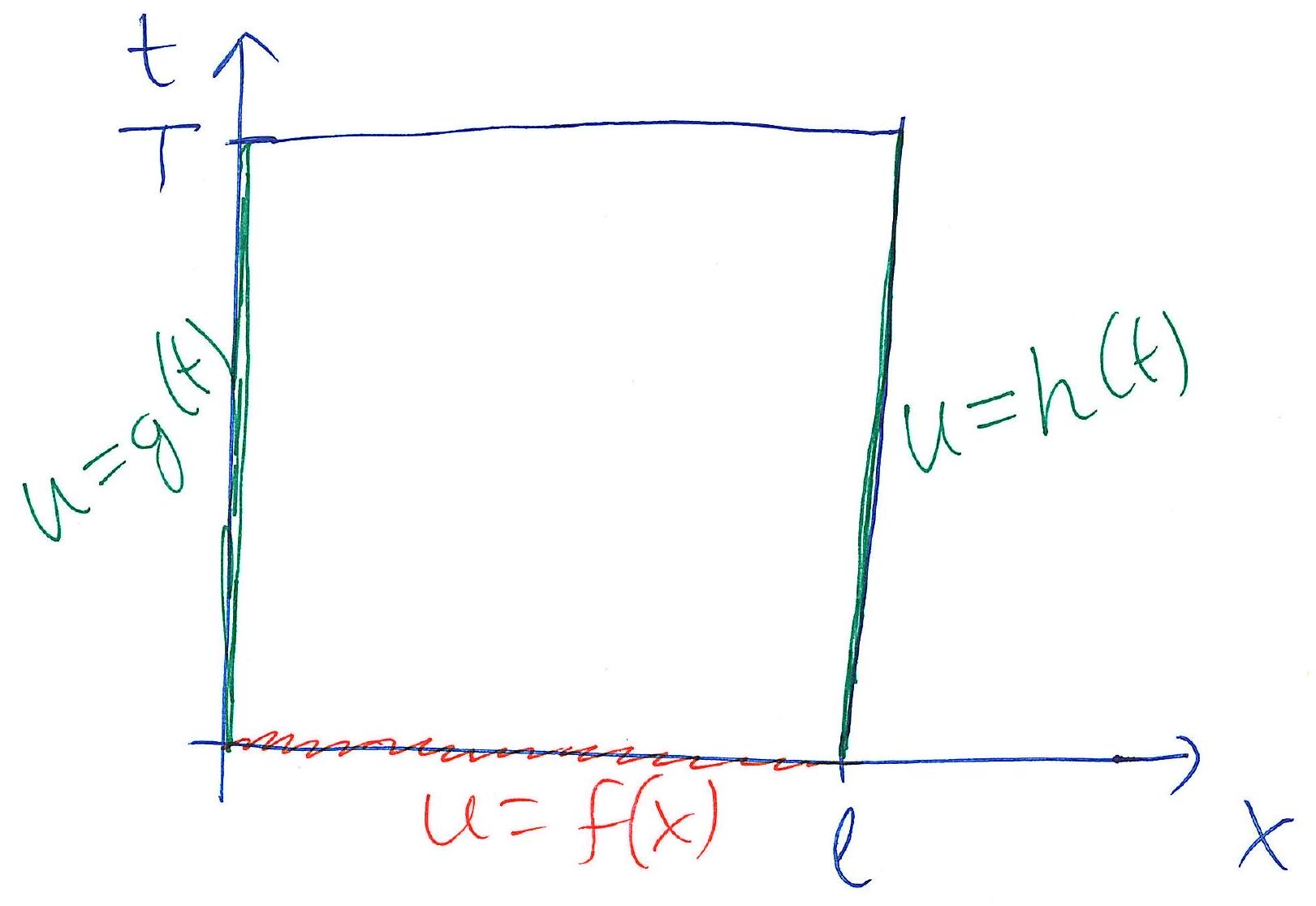
Theorem:
The solution of the IBVP is unique.
Proof:
We assume that there are two solutions and . Set . Then:
So, is a solution of ,
This shows that We want to show that : We introduce the “energy integral”:
; non-increasing : non-negative Conclusion: .
That is,
Only one solution. Uniqueness!
Existence and uniqueness of solution of the IVP .
The Picard iteration
Integral form of the IVP:
Note: If , then all successive elements are also in .
Example:
IVP: . [Exact solution: ]. Solve the IVP using the Picard iteration.
Sequence of functions are Taylor polynomials of :
Theorem (existence and uniqueness of solution of IVP
Let be open. Assume that and that . Then there exists such that the IVP has a solution on (existence). This solution is unique.
Demonstration of lack of uniqueness Consider the IVP
is one solution. is another solution. Note: , .
Cauchy sequences
A sequence where the elements come arbitrarily close to each other when sequence numbers are sufficiently large: For any there exists an integer such that for all
Completeness
A set is complete when all Cauchy sequences of elements in converge to an element in .
Example:
(Complete.) Having established that a sequence in a complete set is Cauchy, we can conclude that the sequence converges to a limit in .
Sketch of proof:
- Define sequence of approximations using the Picard iteration
- Show that this sequence is Cauchy
- Conclude that the sequence converges to an element in .
- This proves existence.
- Assume two different solutions
- Show that gives a contradiction
- This proves uniqueness.
Proof of existence:
The sequence is defined by
Showing that is Cauchy: For , we have
(intinitely many differences)
For each of these differences,
(Lipschitz: differentiable)
By induction we can prove that
where
Essential: (by choice of ).
Going back to |um-uk|:
This proves that
is a Cauchy sequence. We have . is complete (known). Conclusion: The sequence converges to a limit , where
This proves existence of a solution.
Uniqueness of the solution of the IVP
Assume (for later contradiction) that there are two distinct solutions and . Further, assume that achieves its maximum value at . Then:
a was selected such that Kar1] r That is, . Contradiction ⇒ Uniqueness!